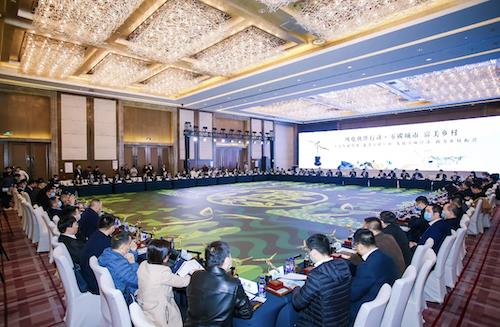
On October 17, 2021, the “Wind Power Partner Action • Zero-Carbon Cities & Prosperous Beautiful Villages” event was successfully held in Beijing. Representatives from 118 cities and more than 600 wind power enterprises jointly launched the initiative, pledging to take practical actions to implement the wind power partner action plan, promote the development of wind energy, build zero-carbon industries together, shape a zero-carbon economy, and make wind power a reliable pillar for achieving rural revitalization and common prosperity through the development of a zero-carbon economy.
Wind power is a key energy source in building a new type of power system, playing a leading role in decarbonizing the power grid and promoting carbon neutrality across the energy sector and society as a whole. The large-scale, high-quality development of the wind power industry is a strategic choice for achieving China’s dual carbon goals. Beyond being a source of zero-carbon electricity, wind power is becoming one of the most economically competitive energy forms, playing an increasingly essential foundational role in local economic and social transformation and development.
To improve development quality moving forward, the wind power industry must expand its circle of friends, forging broad partnerships with local governments, industrial parks, energy-intensive industries, financial institutions, and others, becoming a partner in their journeys to carbon neutrality. The “Wind Power Partner • Zero-Carbon Cities & Prosperous Beautiful Villages” initiative was established as a government-business collaboration mechanism to support localities in achieving dual carbon goals through open, pragmatic, and innovative cooperation. It aims to make wind power an inseparable partner in regional sustainable economic development, contributing significantly to zero-carbon city transitions and rural revitalization strategies.
Su Yujun, Party Secretary of the Yangjiang Development and Reform Bureau, noted that industrial development relies heavily on government leadership. During the 14th Five-Year Plan period, Yangjiang will complete the construction and commissioning of 10 million kilowatts of offshore wind power farms, implement new projects, and promote the creation of a full wind power industry ecosystem covering power generation, equipment manufacturing, R&D and design, testing and certification, and operations and maintenance management — accelerating the construction of a world-class wind power industrial base and national new energy hub.
Xu Peng, Vice Mayor of Rushan City, Shandong Province, highlighted that in recent years, Rushan has made the new energy industry a central driver of its high-end, intelligent, and green industrial transformation. Focusing on offshore wind power equipment manufacturing, the city has planned the Shandong Offshore Wind Power Equipment Manufacturing Industrial Base in Rushan, covering an area of over 10,000 mu (around 666 hectares). The city is striving to build an integrated offshore wind power manufacturing park while developing complementary offshore wind business and financial services industries. Going forward, Rushan will rely on policy guidance and business model innovation to build an integrated wind, solar, and energy storage system, creating a beautiful, livable, and green low-carbon city.
Li Luona, Director of the Jiangyin Lingang Development Zone New Energy Industrial Park, emphasized that controlling carbon emissions is essential for building a beautiful China and is a crucial action for the nation’s ecological civilization construction. The dual carbon goals pose new challenges for energy utilization technology, requiring a comprehensive restructuring of the energy system and driving major social transformations that will reshape global competition. In this process, distributed energy will become a mainstream force, maximizing resource efficiency, demonstrating economic competitiveness, and driving green ecological development while promoting cutting-edge technological progress.
Liu Xiaoqi, Chairman of Guohua Energy Investment Co., Ltd., solemnly read out the initiative’s action plan on behalf of all the guests. The plan focuses on five priority areas:
1. Supporting Zero-Carbon Processes in Urban Industrial Fields
2. Promoting Rural Revitalization and Common Prosperity
3. Developing Affordable Offshore Wind Power to Help Coastal Cities Achieve Carbon Neutrality
4. Exploring New Paths for Green Development by Jointly Building 100% Green Power Consumption Demonstration Cities
5. Enhancing Mutual Understanding and Deepening Cooperation to Build a Healthy New Development Ecosystem
Among these, the two main action lines are:
“Supporting Zero-Carbon Processes in Urban Industrial Fields” and “Promoting Rural Revitalization and Common Prosperity.”
Supporting Zero-Carbon Processes in Urban Industrial Fields
Carbon neutrality represents a profound transformation. It is not only an environmental governance issue but also an economic development transformation issue and a political issue of building a community with a shared future for mankind. Under the new normal of China’s economic development and in response to the dual carbon targets, the industrial sector, a pillar of the national economy, must focus on low-carbon and zero-carbon sustainable development while maintaining stable industrial growth, presenting major challenges for industrial upgrading.
The “Supporting Zero-Carbon Processes in Urban Industrial Fields” initiative aims to foster upstream and downstream collaboration within the wind power industry and promote technological innovation to continuously reduce costs. Zero-carbon electricity bases will be built in wind-rich areas like China’s “Three North” regions, providing highly competitive green electricity to support industrial parks for exports, energy-intensive industrial zones, manufacturing, and data centers relocating to inland areas. This approach can not only ease the emissions reduction pressure in central and eastern China but also promote regional industrial upgrades, enhance economic development, and support the revitalization of Northeast China and the Western Development strategy.
Local governments need to fully recognize the significant economic-driving and emissions-reducing effects of wind power, creating favorable market environments and reducing non-technical costs. The wind power industry aims to lower the Levelized Cost of Electricity (LCOE) in high-, medium-, and low-wind-speed onshore regions to 0.1 RMB, 0.2 RMB, and 0.3 RMB per kWh respectively, and to 0.4 RMB and 0.5 RMB per kWh for nearshore and deep-sea offshore wind power by 2025, providing strong support for local economic development.
Promoting Rural Revitalization and Common Prosperity
Strengthening collective economies and revitalizing rural areas requires adhering to the recently emphasized principle by President Xi Jinping: “Promote common prosperity through high-quality development.” Villages and towns should leverage their own resources — relying on mountains and water where available — to choose suitable development paths. As an abundant, ubiquitous, and inexhaustible green energy resource, wind power offers natural advantages in many rural regions of China.
Through the “Promoting Rural Revitalization and Common Prosperity” initiative, wind power will be integrated with new energy-themed towns, regional tourism, and other projects to fully harness its economic value. This approach ensures that rural communities can directly benefit from wind power development, effectively expanding village collective economies.
Local governments should provide policy support for wind power land use, grid connection, and other facilitation measures, coordinating with national policy planning. Together with the wind power industry, the “Thousand Towns, Ten Thousand Villages Wind Action Plan” will be launched, starting with the “Hundred Counties, Thousand Villages, Ten Thousand Turbines Demonstration Project” in favorable regions. The goal is to launch the first batch of 10 county-level demonstration projects with a total capacity of 5 million kilowatts by the end of 2021. During the 14th Five-Year Plan period, 10,000 wind turbines with a total capacity of 50 million kilowatts will be installed across 5,000 villages in 100 counties, providing long-term, stable income for over 3 million rural residents.
[INSERT PHOTO HERE]
Wu Gang, Chairman of Xinjiang Goldwind Science & Technology Co., Ltd., Zhang Chuanwei, Secretary of the Party Committee and Chairman of Mingyang Smart Energy Group Co., Ltd., and Wang Yongliang, Standing Committee Member and Deputy General Manager of Beijing Energy Group Co., Ltd., spoke as representatives of wind power enterprises.
Wu Gang noted that this event gathered government institutions, developers, manufacturers, and related wind power enterprises, calling for unity to build a zero-carbon society. He also identified key pain points in the industry:
1. Improving land use application processes
2. Establishing evaluation standards for high-energy-consuming enterprises using green power and creating a market mechanism for enterprise “carbon accounts.”
Golden Wind will continue to promote technological innovation and process improvement, consistently reducing product lifecycle carbon emissions and jointly achieving green energy substitution with local governments.
Zhang Chuanwei remarked that advancing the “Hundred Counties, Thousand Villages, Ten Thousand Turbines” initiative with over 100 cities and 600 enterprises will be an extraordinary rural development project. The active participation of so many cities and businesses gives them confidence that through extensive rural-to-urban, agricultural-to-industrial, community-to-park transformations, China’s low-carbon development will lead globally.
Wang Yongliang proposed that Beijing Energy Group Co., Ltd. will focus on three areas:
1. Zero-carbon homes, towns, and industrial parks starting from Xilingol League
2. Large-scale green electricity trading through platform-based, market-oriented grid cooperation
3. Building user-side zero-carbon industrial parks.
By advancing on all three fronts, the future of wind power will be bright.
As an ongoing, open, and cooperative platform, the “Wind Power Partner Action • Zero-Carbon Cities & Prosperous Beautiful Villages” initiative adheres to principles of voluntary participation and mutual benefit. Partner cities and wind power enterprises will form comprehensive forward-looking partnerships, actively connecting in fields such as new and old economic driver transitions. Wind power enterprises will prioritize partner cities for project investments, fully leveraging industry resources, uniting domestic and international academic and research forces, and providing comprehensive services for partner cities in areas like zero-carbon industrial planning, economic growth models, low-carbon energy tech development, rural revitalization, and integrated social development — achieving “one city, one strategy” for green, sustainable, and leading transitions, creating model zero-carbon development cities and prosperous beautiful villages across China.